

Outstanding Public Outreach, Program, Project, Tool, Community Initiative
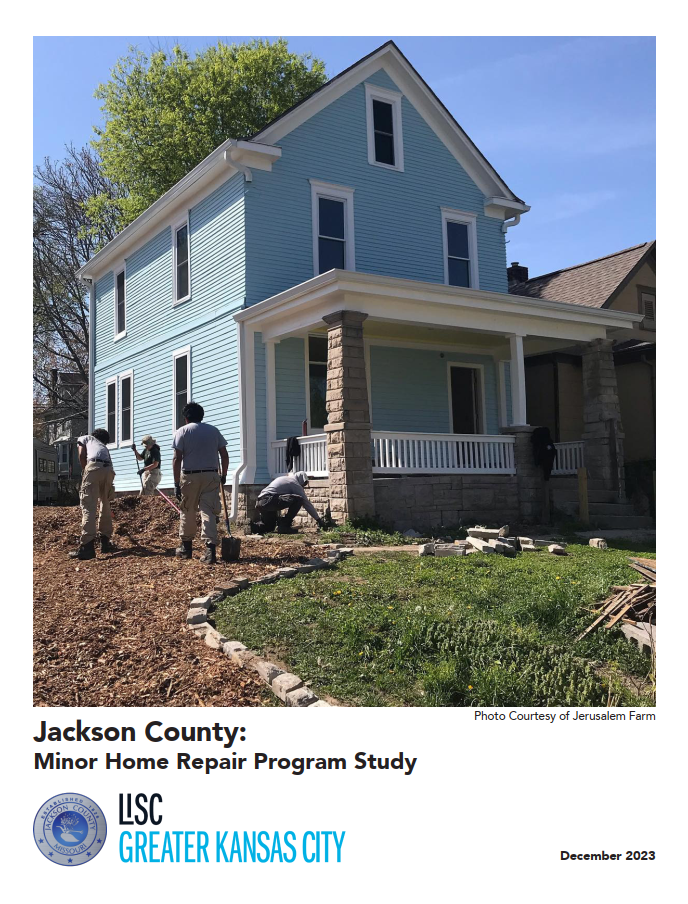
Jackson County Minor Home Repair Program Study
The Jackson County Minor Home Repair Study is about helping people remain safely and comfortably in the communities they love. Commissioned by Local Initiatives Support Corporation (LISC) Greater Kansas City and led by Hoxie Collective, the study examines the growing demand for minor home repair services across Jackson County– and the challenges faced by both homeowners and providers in meeting that demand.
Through interviews with seventeen nonprofit and public-sector service providers, the study maps the network of organizations offering repairs, aging-in-place solutions, and energy efficiency retrofits to low-income and senior homeowners. It highlights systemic challenges – long wait times, limited contractor availability, inconsistent outreach– and elevates opportunities for shared solutions. More importantly, it delivers a practical roadmap to strengthen coordination, funding, and community engagement so more residents can access critical repairs before small issues become crises.
The study was built around the experiences of those doing the work, including service providers, city staff, and other housing advocates who collectively serve over 2,500 households annually. Each interview focused on understanding the scope of services, application and intake processes, funding sources, and the pain points preventing timely service delivery. Across all interviews, themes emerged: referrals between organizations are common, but without real-time updates on capacity they do not always reduce the wait times– which can range from six months to over a year. A few providers have more funds than applicants and struggle with community awareness. Most operate without a formal waitlist, relying on emergency triage and informal prioritization of health needs.
The engagement revealed a system of committed organizations offering a variety of services in different ways. The study outlines how coordination can be improved and expanded to serve the thousands of households in need– especially in aging housing stock where residents are living on fixed incomes. This strategy also addresses increased communications for homeowner awareness, enhanced organizational capacity, and county investment.
For the individual homeowner level, the study recommends a focus on coordinating consistent, multilingual communication to help residents understand and access available programs. The study also provides a user-friendly guide listing services by provider, eligibility criteria, and repair types, along with complementary resources like tax abatement options, estate planning descriptions, and home maintenance guides.
At the organizational level, the study recommends shared tools– like a common intake form, a real-time capacity tracker, and contractor training programs to reduce administrative burden and
expand the skilled workforce. The study also includes national case studies and funding resources to model cross-sector solutions.
At the County level, the study offers long-term solutions, such as a housing trust fund, coordinated public funding strategies, and a standing coalition or task force to ensure accountability and resource alignment. An appendix of county-level maps visualize housing age, income, and owner-occupancy trends to prioritize areas most at risk.
This study centers Planning as a tool for systems coordination and community resilience. It reframes home repairs as a part of a larger planning strategy at the intersection of aging housing stock, aging populations, health factors, energy efficiency, and community organizing. It shows how partnerships with regional repair service providers, County staff, and community-based organizations can lead to tangible improvements in community stability. Ultimately, this study exemplifies how planners can facilitate cross-sector dialogue, align strategies with lived experiences, and create tools that have both immediate and long-term impact.
Jackson County Minor Home Repair Program Study
Missing Middle Housing Neighborhood Workshops
As part of the comprehensive update of the land development code which Forward SGFSpringfield’s Comprehensive Plan identifies as a major step towards reaching the city’s housing goals, staff from the Planning and Neighborhoods division facilitated a series of interactive workshops with residents in select center city neighborhoods. These workshops were designed to educate and engage the public on what “missing middle” housing options are and explore how a newly created Low-Density Mixed Residential (R-MX1) zoning district could be thoughtfully integrated into existing neighborhoods. This innovative effort directly supports the citywide remapping process that follows City Council’s adoption of an updated Land Development Code.
Rather than relying solely on staff to identify where increased density might be appropriate, the city invited residents to take a central role in the planning process. Through a presentation and guided mapping exercise, participants pinpointed specific sites within their neighborhoods where they would support a transition to R-MX1 zoning, which permits housing types such as duplexes, townhomes, and small multi-unit buildings. This proactive, participatory model empowered residents to help guide how their neighborhood can grow in a way that supports housing diversity while respecting the neighborhood character.
Workshops were conducted in nine historic center city neighborhoods—Woodland Heights, West Central, Westside, Heart of the Westside, Grant Beach, Midtown, Tom Watkins, Doling, and Weller—chosen because of their early-20th-century development patterns, traditional street grids, alleys, and walkable infrastructure. Planning staff engaged with approximately 200 residents and property owners who collectively identified around 4,569 properties as potential locations for missing middle housing. Notably, 3,785 of these sites are currently zoned R-SF (Single-Family Residential) and could be considered for future rezoning to expand housing options.
This initiative produced a community developed set of data that staff can use to help guide future zoning decisions, and deepened public understanding of what planning is and what planners do. Many participants were engaging with the City’s planning process for the first time. The workshops helped demystify zoning concepts and offered a platform for residents to have their concerns heard and discussed. In addition to mapping locations with potential for missing middle housing, participants raised broader issues including the need for code enforcement, a rental inspection program, improved alley and park maintenance, and infrastructure upgrades to support higher density residential uses.
The process also revealed common concerns about neighborhood change, including balancing rental and owner-occupied housing, managing parking demand, and ensuring equitable distribution of new housing types across all neighborhoods. Staff have analyzed the input gathered and developed neighborhood-specific maps to be shared with neighborhood leadership and presented to City Council as a recommendation for action.
These missing middle workshops represent a planning approach grounded in transparency, education, and community support— that allowed staff to begin building trust and generating actionable input. By giving residents an active role in shaping the decisions that will directly affect them, this effort lays the groundwork for more inclusive, equitable growth and revitalization and helps make sure planning and planners remain connected to the people they serve.
Missing Middle Housing Neighborhood Workshops