

Outstanding Plan
Boone County Master Plan
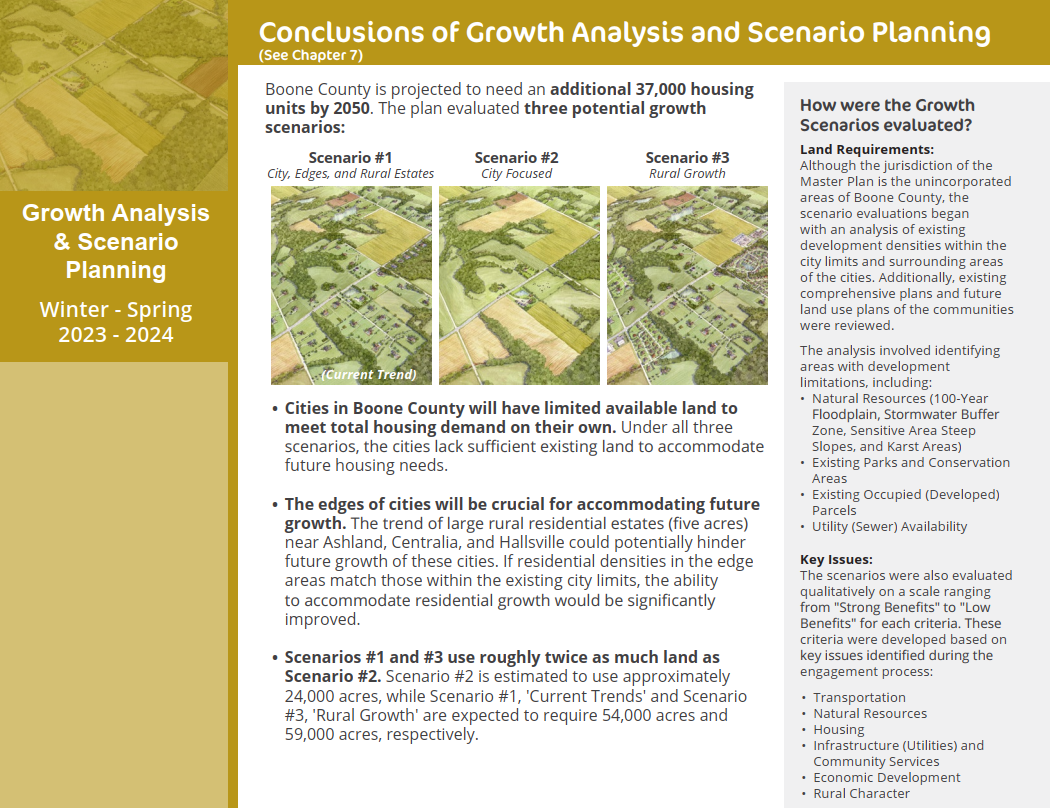
Boone County, home to Columbia, Missouri, and the University of Missouri, has been one of the fastest-growing counties in the state, with a population increase of over 34% since 2000. To accommodate continued growth, Boone County is projected to need more than 37,000 additional housing units by 2050.
The Boone County Master Plan was innovative in gaining consensus to balance growth, recommending higher residential densities and economic development in areas efficiently served by infrastructure and community services, while promoting the preservation of farmland and natural resources in other parts of the county.
Through scenario analysis, the plan clearly communicated to the public that continuing recent trends of low-density residential development would hinder the County’s ability to meet future housing needs. The plan also stood out for its use of easy-to-understand graphics and clear explanations of the fiscal impacts of low-density development, as well as conservation tools available to protect farmland and natural areas.
Finally, the plan helped build public trust by illustrating many of its recommendations with precedent examples from Boone County and other Midwestern counties.
Boone County Master Plan
St. Louis County 2050: An Equitable & Sustainable Comprehensive Plan
STLCO 2050 was carefully crafted over more than 18 months. In addition to the dedication of the project team, the Plan is a result of hours upon hours of conversations with County stakeholders. Residents, business owners, community leaders, elected officials, nonprofits, educational institutions, advocacy organizations, and municipal partners helped shape the vision in STLCO 2050. STLCO 2050 is grounded in sustainability and equity. To realize these values, the Plan develops avenues for every community member to achieve social and financial wellbeing. Additionally, an emphasis on sustainability is necessary for mitigating our region's environmental challenges. Achieving vitality, growth, and prosperity can be accomplished in a manner that generates opportunity that is lasting and accessible to County residents and neighbors from all walks of life.
Rather than a print document, STLCO 2050 exists as a website. This format provides users the flexibility to interact with datasets and navigate various topic areas and plan recommendations. In lieu of traditional chapters of the Plan for Land Use, Housing, Transportation, Economic Development, and Open Space, the 200 policy recommendations in STLCO 2050 are organized into Five Big Policy Buckets which are intertwined and connected to various topic areas. For example, when we think about how to promote greater housing diversity and affordability, we need to think about how housing can be accessible by different types of transportation and what economic impacts this has on the community. One cannot think about housing solely in terms of land use and development. Each recommendation addresses at least one of the Five Key Issues and multiple planning topic areas that lead to achieving the Five Desired Outcomes.
STLCO 2050 is holistic in nature and covers many topics. The plan provides a platform for the County to coordinate with our regional partners and stakeholders to align existing policies and create new ones that support the entire region. Through extensive engagement and civic dialogue, this plan is the community's plan, serving as the blueprint for collective action as we work towards our shared goals.
St. Louis County 2050: An Equitable & Sustainable Comprehensive Plan